THE PAST
A practical guide to understanding your past. We’ll explore how your experiences have shaped your beliefs, the patterns you carry, and what you believe you’re capable of. Along the way, you’ll find questions to help you apply what you’re reading to your own life.

By Dylan Thompson
·
Oct 23, 2026
·
20 min read
There’s a reason you’re here, and I don’t think it’s as simple as wanting to start an online business. Maybe that’s the answer you’d give someone if they asked. You want to make money online, work for yourself, live where you want, and have more control over your life. Those are the easiest parts to explain because they describe what you want your life to look like. What’s harder to explain is why those ideas carry so much weight for you, or why staying where you are has started to feel so heavy.
Before we get into the practical side of building an online business, the first part of this course will help you understand the person who wants that life in the first place. We’ll explore where that desire came from, what shaped your ideas about work, money, success, and freedom, and which parts of your past may still influence the choices you make now. Then, once that becomes clearer, we can start looking at the future you’re trying to build. Only then will we move into the practical work: choosing ideas, creating offers, building websites, making content, using AI, running paid ads, and turning a thought into something real. Because beneath all of that, there’s a deeper reason this matters to you.
At some point, the life you’re living started to feel too small. You may still be doing everything you’re supposed to do. You may have a job, a routine, bills to pay, and people around you who think you’re doing fine. From the outside, nothing may look obviously wrong. Yet part of you keeps wondering whether this is really it. You look ahead and struggle to see yourself living the same way much longer. The thought of spending most of your life working inside someone else’s plan grows heavier, and the idea of building something of your own keeps coming back.
It’s easy to picture what that business might give you once it’s working. You imagine the money, the freedom, the home, the people you could help, and the person you might finally become. What’s harder to picture is everything between where you are now and that future. It’s sitting down when you don’t know what to build. It’s choosing an idea when you’re scared of choosing the wrong one. It’s putting a website online when part of you already thinks it isn’t good enough.
That’s why we need to understand the person who’s building the business before we focus on the business itself. We’ll go back through the past and look at how you learned to think about work, money, success, risk, and freedom. We’ll look at the role you learned to play and how that role may still shape your choices today.
Once you understand where you’re starting from, we can begin looking at where you want to go. We’re going to start by asking what kind of life you’re trying to create. Where do you want to live? How do you want your days to feel? How much money do you need? How much responsibility do you want to carry? Do you want a small business that supports a simple life, or do you want to build something larger with a team around you?
When that life starts to take shape, we can ask what kind of business could support it. We can also ask the harder question: who do you need to become to build and maintain it?
This gives you a direction, but direction alone won’t change your life. At some point, you have to start building. You’ll begin making decisions, creating offers, building pages, using AI, making content, finding people to work with, and putting ideas in front of the market. Some of it will go well, and some of it won’t. You’ll change your mind, make mistakes, waste time, and run into problems you didn’t know existed. That back-and-forth doesn’t mean the process has gone wrong. It’s how the idea becomes clearer.
You can’t think your way into becoming an entrepreneur. You can learn the ideas, understand the psychology, and create a clear direction, but part of who you need to become will only appear once something real happens. You don’t know how you respond to rejection until someone says no. You don’t know how patient you are until you’ve worked on something for months and it still hasn’t turned out the way you hoped.
Those moments are where the real work happens. Problems, delays, weak ideas, failed tests, and changes in direction give you something planning can’t. They give you experience, and experience lets you see yourself more clearly.
This course is called the Telos Blueprint because telos means direction, purpose, or the end toward which something is moving. The blueprint isn’t a perfect map of everything that will happen. It helps you understand where you’ve come from, choose where you want to go, and create enough direction to get moving.
Your past explains your starting point. Your future gives you something to move toward. Your present is where you build the skills, gather the experience, and become capable of creating the life you imagined.
That’s what this course is really about.
Before we start, though, I want you to have somewhere to write, because throughout this Blueprint I’m going to ask you questions that I actually want you to answer. Some of them you’ll probably know immediately. Others might take a little longer, and you may come back to questions days later because something happens in your life and the answer suddenly becomes clearer.
You don’t need anything complicated. Grab a notebook, open a document on your computer, use the notes app on your phone if that is what you have. The important thing is to have somewhere to capture what comes up, instead of watching this like another video and assuming you’ll remember everything later.
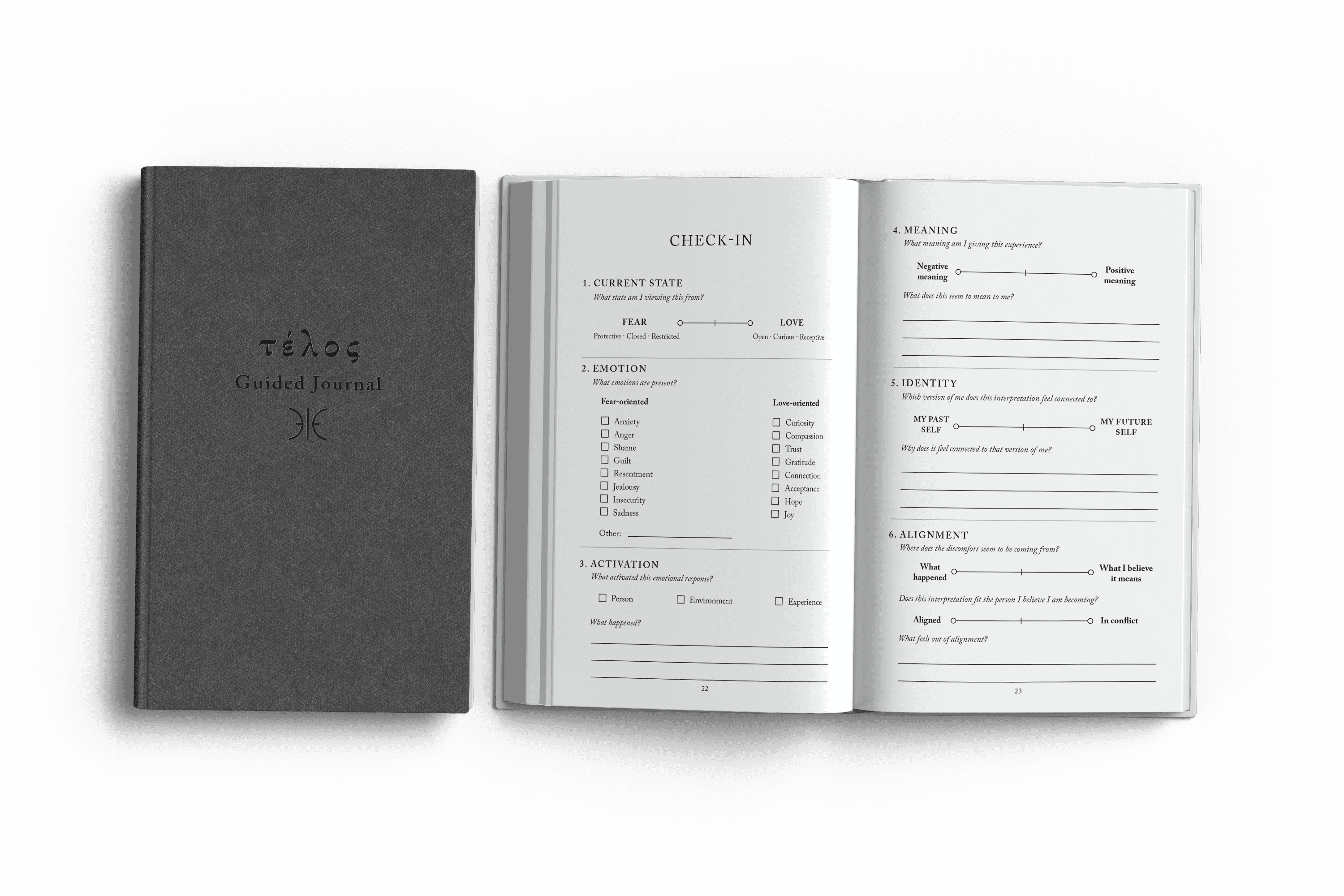
I have also created the Telos Guided Journal and Telos Notebook specifically for this process.
You don’t need it, and I want to be clear about that. You can write everything important we do together in whatever you already have. The Journal simply gives the process a dedicated home. The exercises we’ll work through here are already organised inside it; it also includes additional questions for when you want to explore something further, and ongoing check-ins you can use after you finish this course so the work doesn’t disappear the moment the videos end.
Whichever way you choose, I want you to write.
Because from this point forward, the value won’t come from what I say.
The value will come from what you notice when the questions become personal.
So let’s start somewhere very different from where we started in the Past video.
I want to start with your life today.
So instead of asking what happened to you in the past, I want you to look at the life you’re trying to build and ask a more useful question.
Where is your past still making decisions for you now?
Take a few minutes with that question. Look at the situations ahead of you that create the strongest hesitation, resistance, fear, embarrassment, pressure, or need to control what happens. You don’t need to understand why yet, and you definitely don’t need to fix anything.
Just find one.
One situation where you can already feel something inside you wanting to pull away, tighten up, prepare for the worst, or make absolutely certain nothing goes wrong.
Write it down.
Instead of spending this section talking about how your past shaped you, we’re going to take that reaction apart together and find out what it's been trying to do for you.
So look at the situation you just wrote down.
Maybe you already know exactly what it is. Something is keeping you from doing what you know you need to do, or it's something about the life ahead that creates more resistance than everything around it. If nothing obvious comes to mind, think about the next few months rather than your entire future. What are you likely to have to do if you genuinely start moving toward the life you say you want?
Maybe you need to publish something with your name attached to it. You might have to tell people what you’re building before you know whether it will work, put a price on something you created, spend money without knowing exactly what will come back, or have a conversation with somebody who may not understand why your direction is changing.
The situation itself doesn’t really matter yet. What I want you to notice is what emotion appears when you picture yourself actually doing it.
So close your eyes for a moment if that helps and place yourself there.
Imagine that the decision has arrived. You can’t keep researching it, planning around it, or telling yourself you’ll deal with it eventually. It is sitting in front of you now, and you have to respond.
What happens?
Where does your mind go first?
What do you start worrying about?
What suddenly feels important that didn’t seem nearly as important when the situation was still somewhere in the future?
Perhaps you start looking for more information because you don’t feel ready. You convince yourself the timing isn’t quite right, the idea needs more work, or waiting another week would make the decision easier. You may even want to abandon it and move toward something that feels cleaner, safer, or easier to control.
I don’t want you to judge any of that.
Just watch it.
If you were sitting across from me telling me what was happening, I wouldn’t care whether the reaction looked logical from the outside. I would want to know what the reaction is trying to prevent.
What are you afraid will happen if you move forward?
And I want you to go a little deeper than the obvious answer.
If you’re afraid the business will fail, what about failure actually bothers you?
Is it losing the money?
Is it having to start again?
Is it the possibility that you might put everything you have into something and discover that you aren’t as capable as you hoped?
Are you worried they won’t like the work, or are you imagining someone you know seeing it and changing how they think about you?
You don’t need ten answers.
I want the one that makes you pause.
Usually there is a point where the question stops feeling intellectual, and you notice that something underneath the behaviour has a little more emotional weight than you expected.
That is the reaction we’re looking for.
Write down the situation, then write what you think you are trying to prevent from happening.
Be as specific as you can.
“I’m afraid of failure” doesn’t tell us very much yet.
But “I’m afraid I’ll spend a year doing this, tell everyone what I’m building, and eventually have to admit that I couldn’t make it work” now that gives us something we can actually explore.
So, take the reaction you just wrote down and look at it again, because now I want to understand why it carries so much weight for you.
You already know what creates the hesitation, fear, pressure, or resistance. The next step is to ask what you think will happen if you move forward. If publishing something makes you anxious, what are you really imagining on the other side of that decision? Someone might criticise the work, but what would that criticism mean to you personally? Would it feel embarrassing, exposing, or like proof that you never really had anything worth saying in the first place? If money drives the reaction, stay with that instead and ask what losing it would actually mean to you. Would it simply mean having less money, or would it make you feel irresponsible, unsafe, stupid, or like you should have known better than to take the risk?
The point here is to keep following the reaction until it stops sounding practical and starts feeling personal, because that is usually where the real pattern begins to show itself.
Once you reach that point, ask yourself where else in your life you have felt something similar. You don’t need to find the perfect memory, and you don’t need to decide exactly where the pattern started. Just let your mind move through the experiences that carry the same emotional shape. When have you felt this exposed before? When did getting something wrong feel like more than making a mistake? When did losing control become something you learned to avoid?
Something may come up immediately, or you may notice that there wasn’t one dramatic moment at all. Sometimes you can point to a clear memory, but often it is years of smaller experiences that kept teaching you the same lesson until you stopped questioning it.
That is what I want you to find.
Look at the experiences that came up and ask yourself what they taught you at the time, not in psychological language, but in the language you would actually have carried forward. Maybe the lesson was, “If I take risks, something goes wrong,” or, “I’m better off handling things myself.” Yours might be completely different, but whatever comes up, try to write it as simply and honestly as you can.
Then take that rule and place it beside the situation you are dealing with today.
Does the reaction make a little more sense now?
That doesn’t mean the current risk isn’t real, and it doesn’t mean everything uncomfortable in your life is just an old wound being replayed. You may have completely valid reasons to be cautious. We're trying to understand whether you are responding only to what is happening in front of you now, or whether the situation has also picked up emotional weight from somewhere you have already been.
That distinction matters because the business problem in front of you may be completely new, while you've practised responding to it for years.
So before you continue, write down the situation you are facing now, the earlier experiences that seem connected to it, and the rule you think you learned from those experiences. Then sit with that rule for a moment and ask yourself one more question.
When this rule gets activated, who do I become?
Understanding what you learned is useful, but next we need to see the version of you that learned to live by it.
Think about what actually happens to you when the situation we’ve been exploring starts to feel real. Do you disappear into research because learning feels safer than making a decision? Perhaps you stop asking for help, convince yourself you can handle everything alone, or start looking for another direction the moment the one you chose becomes difficult.
I’m less interested in what you call the behaviour than in what it does for you.
If you spend weeks perfecting something before anybody can see it, what does that extra time give you? Maybe it gives you a sense of control. If you keep researching instead of choosing, perhaps the research gives you somewhere productive to hide while every possible direction can still remain untouched by failure.
Seen this way, it becomes harder to call yourself lazy, indecisive, controlling, or scared. The behaviour usually survived for as long as it did for a reason. At some point, it helped you manage something so difficult that your mind learned to return to the same response whenever a similar feeling appeared.
So I want you to ask yourself what your version of that response is.
When you feel exposed, what do you do?
When you don’t know whether something will work, where do you go?
When there is a real possibility of rejection, losing money, making the wrong decision, or discovering you aren’t as ready as you hoped, what version of you tends to take over?
Try to describe that person without turning them into a diagnosis. You might notice you become the person who has to know everything before starting, the person who keeps everyone else happy, the person who handles everything alone, or the person who leaves before anyone else gets the chance to decide whether you belong there. The label itself isn’t important. What matters is recognising the pattern when it appears.
Then ask the question underneath it.
What is this version of me trying to protect me from?
Stay with that for a moment, because the answer may be different from the thing you thought you were avoiding. Control may look like competence while protecting you from having to trust somebody else. Constantly changing direction can look like curiosity while keeping you from staying with one thing long enough for reality to tell you whether it works.
Once you understand what the response protects you from, look at what it gives you immediately.
That part matters because these patterns usually survive for a reason. Delaying the launch can reduce anxiety tonight. Changing the idea can give you back the excitement you felt before it became difficult. The response works in the short term, which is exactly why it becomes so easy to repeat.
Then look a little further ahead and ask what that same response costs you when it becomes how you handle every difficult moment.
The need for certainty can keep you standing still while you wait for an answer that real life will always make you discover through experience.
That is the tension I want you to capture in your notes.
When this situation appears, what do I do?
What does that response protect me from?
What does it give me immediately?
And what does it cost me if I keep using it?
You don’t need to change the pattern yet. Right now, I just want you to recognise it clearly enough that, the next time it appears, you can notice something more is happening than whatever answer your mind gives you in the moment.
Because we now have almost everything we need.
We have the situation that activates you, the experiences that seem connected to it, the rule you carried forward, and the response you learned to use whenever that rule gets threatened.
The next step is to put those pieces together and see the entire pattern as one process, because once you can see the loop clearly, it becomes much harder for the pattern to hide inside a hundred different situations and convince you that each one is a completely new problem.
Let’s go back to the situation you started with and walk yourself through what actually happens from beginning to end.
Something happens first. Maybe you need to publish the video, spend the money, make the offer, choose the idea, have the conversation, or make a decision without knowing whether it will work. That is the situation in front of you, and before you've done anything, your mind starts predicting what might happen next.
What does it predict?
Maybe you imagine being judged, losing money, making a bad choice, disappointing someone, looking stupid, or discovering you are not as capable as you hoped. Whatever the prediction is, write it down as clearly as you can, because that prediction is usually what gives the situation its emotional weight.
Then ask yourself what it would mean if the prediction came true.
This is where the rule you found earlier comes into play. Being criticised might mean that you should never have put yourself out there. Losing the money could mean that you are irresponsible. Needing help might mean that you cannot handle things yourself. The event and the meaning are different, but when they happen quickly enough, they can feel the same.
Once that meaning appears, notice what you feel and what you want to do next.
Perhaps you become anxious and start researching. You feel exposed and begin perfecting everything. You feel uncertain and try to control more of the situation. You feel the possibility of failure, and suddenly another idea looks much more attractive. The protective response we just explored starts making sense because it gives you a path to move away from whatever the prediction has made you feel.
Then comes the part I want you to pay close attention to, because this is often where the loop becomes self-sustaining.
What happens immediately after you use the response?
If you decide not to publish, the anxiety drops. If you postpone the decision, you no longer have to find out whether you were wrong. If you abandon the idea and start researching another, the first idea's uncertainty disappears, and possibility feels exciting again.
For a moment, the response works.
That immediate relief teaches you something. The next time a similar situation appears, your mind already knows which response reduced the discomfort last time, so it becomes easier to use again. After enough time, you can end up with a pattern that feels automatic, even though you learned every part of it through experience.
This is the loop I want you to map.
Start with the situation.
Write down what you predict will happen,
what you believe that outcome would mean,
what you feel when that meaning appears,
and what you do to protect yourself from it.
Then write down what that response gives you immediately and what it costs you if you keep using it over time.
When you put it all on one page, you may start noticing something you couldn't see when you were only looking at the behaviour.
The behaviour is not the beginning of the pattern.
By the time you are procrastinating, perfecting, avoiding, controlling, changing direction, or doing everything yourself, a lot has already happened inside your mind. You have entered a situation, predicted an outcome, attached meaning to that outcome, felt something in response, and then reached for a behaviour that helps you manage it.
That is why trying to change the behaviour by itself can feel so frustrating. You tell yourself to stop procrastinating without asking what the procrastination is helping you avoid. You promise yourself you will stop overthinking without looking at what certainty is doing for you.
So instead of fighting the last part of the loop, I want you to learn to recognise the whole thing as it happens.
The next time you notice yourself pulling away from something you said mattered to you, come back to this page and ask where you are in the loop. What happened? What are you predicting? What are you making that prediction mean? What are you feeling now, and what response suddenly seems like the safest thing to do?
You may still choose the same response. Sometimes the risk is too high, the idea needs more work, or trusting somebody would genuinely be a mistake. The purpose of the loop is not to teach you to ignore caution. It gives you enough space to tell the difference between a decision you are making now and a response you have practised so many times it already feels decided.
That is the difference we are trying to create throughout this entire Blueprint.
A little more space between what happens to you and what you automatically do next.
So take some time now and complete the loop for the situation you have been working with. Once you can see it clearly, look back across your life and ask whether the same structure appears anywhere else. The details may change while the pattern underneath remains surprisingly similar.
You might realise the same need for certainty shows up in money, work, and relationships with other people.
Because once you can see those patterns on the page, you can stop looking at isolated reactions and start building something more useful: a map of the parts of your past that are most likely to travel with you into whatever you build next.
This is where I want you to step back from the individual situation we have been working through and look at yourself more broadly. You are not trying to create a complete psychological profile of who you are, because I don’t think that would be useful here. What we need is a practical map of the patterns most likely to matter as you start moving toward a different life.
Start with the rule you uncovered earlier and ask yourself what other rules seem to sit beside it. When you think about money, success, risk, visibility, work, failure, asking for help, or being responsible for something that may not work, what beliefs seem to appear again and again? You may notice that you expect yourself to have everything figured out before you begin, that depending on other people feels uncomfortable, or that making the wrong decision carries far more meaning for you than the decision itself probably deserves.
You don’t need a long list. I would rather you identify two or three patterns that genuinely shape how you move through life than fill a page with every belief you have ever noticed about yourself.
Then look at who you tend to become when those patterns are activated. We have already done this with one situation, so now you are asking whether the same protective version of you appears elsewhere.
Now ask yourself what each of those responses has been doing for you.
This is important because I don’t want you leaving this section looking at your past as a collection of problems you need to remove. A lot of the ways you learned to respond probably helped you somewhere. The person who plans for every possibility may have learned how to create stability when life felt unpredictable. The person who became incredibly independent may have developed problem-solving skills that will serve them for the rest of their life.
We aren’t trying to throw those parts of you away. We are trying to understand when something that once helped you begins choosing for you automatically.
So beside each pattern, write down what it gives you and what it may cost you in the direction you are trying to move.
If being independent has made you capable and resourceful, keep that. But if the same independence makes it almost impossible to trust people, delegate, or eventually build a team, that matters too.
I want you to end up with a page that helps you see yourself without needing to explain your entire history every time something gets difficult.
You should be able to look at it and recognise the important rules you carried forward, the version of you that tends to appear when those rules are threatened, what that response is trying to protect, and where the same response may begin working against the future you are trying to create.
Then add one final piece.
Where do you expect each pattern to show up next?
Look at the life you are about to start designing and the business you may eventually build. Where are these parts of you most likely to become active? Perhaps you already know visibility will bring up judgement, that spending money will test your relationship with security, or that working with other people will challenge the part of you that has always felt safer doing everything alone.
Write those situations down beside the pattern.
You are not predicting that something will go wrong. You are giving yourself a way to recognise what is happening when the moment eventually arrives.
That is your Pattern Map.
It doesn’t need to explain everything about you, and it will probably change as you gain new experiences and understand yourself differently. Its purpose is much simpler. It gives you a picture of what you are bringing into the next part of your life, so when an old pattern eventually appears in a new situation, you're more likely to recognise it before it makes the decision for you.
And that is really all I want from the past before we move forward.
You now have something practical that shows you where that history is most likely to matter, what it tends to activate inside you, and what you need to pay attention to as your life begins changing.
Because now that you have a clearer picture of what you are bringing with you, we can finally ask where you actually want to go.
Need help applying these ideas to your own life?
The Telos Guided Journal was designed to help you apply these ideas to your own identity, experiences, and direction.